
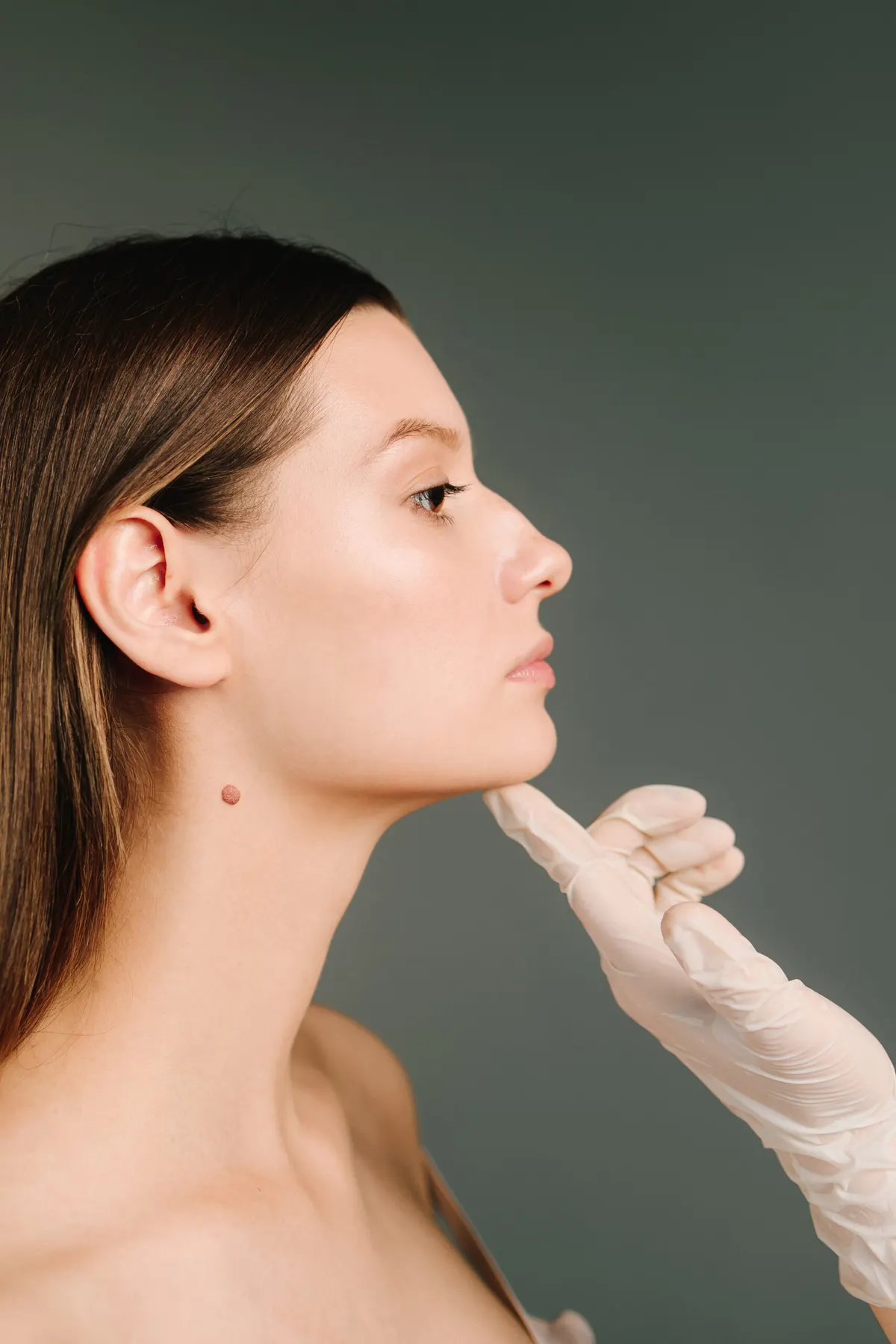
Skin tag removal
Skin TagRemoval.
In-clinic removal of benign skin tags, after assessment to confirm that what you have is actually a skin tag and not something that needs a doctor.
At a glance
- Performed by
- Trained clinician, lesion assessment reviewed by our Medical Director
- Price
- from $150 for the first 20 minutes From $150 for the first 20 minutes. Cherry angiomas and broken capillaries are treated with BBL at the same rate.
- Consultation
- Free
What it is
What skin tag removal
actually does.
The assessment is the important part
Removing a skin tag is quick. Deciding that it is a skin tag is where the responsibility sits, and it is the reason to have it done here rather than with a kit from a pharmacy.
Skin tags, properly called acrochordons, are soft, skin-coloured, benign growths hanging from a narrow stalk. They are among the most common lesions on the human body and they are entirely harmless. They appear where friction happens: the sides of the neck under a collar, the underarms, the eyelids, beneath the breasts, and in the groin.
But plenty of other things are soft, small and raised. Seborrhoeic keratoses, benign moles, dermatofibromas, warts and, occasionally, lesions that need proper medical assessment can all be mistaken for a skin tag by the person who has it.
We look at every lesion before we agree to remove anything, and our Medical Director reviews what we are treating.
What we will not remove
Anything pigmented, anything with an irregular border, anything asymmetric, anything firm or fixed, anything growing, bleeding, itching, ulcerating or changing.
Moles are not removed here as a cosmetic procedure. A pigmented lesion needs to be assessed by a physician or dermatologist, and if there is any question about it, it needs to be examined properly, not shaved off in an aesthetic clinic. We will tell you to see your doctor. That is not us declining a booking to be cautious; it is the only defensible way to handle a pigmented lesion.
How removal is done
For a small tag on a thin stalk, fine excision at the base is quick and clean. For others, a plasma device or cautery is used to remove the lesion and seal the base at the same time, which is useful in areas that bleed readily.
The common principle is that the tag is removed at its base. Reducing a lesion without dealing with the base leaves you with the same problem in a slightly smaller form.
Why home removal is a bad idea
Thread ligation, over-the-counter freezing kits and scissors are all in wide circulation, and all three carry the same three risks: infection in an area you cannot keep sterile, a scar worse than the lesion, and bleeding that is harder to stop than you expect on the neck or eyelid.
The fourth risk is the serious one. If the lesion was not a skin tag, destroying it at home removes the thing a doctor needed to look at.
Who this suits
Anyone with confirmed benign skin tags that catch on jewellery, collars, razors or clothing, or that they would simply rather not have.
Who it does not suit
Anyone with an undiagnosed or pigmented lesion, which needs a physician first. Anyone with active infection in the area. Anyone with a history of keloid scarring, without a careful conversation about the trade-off beforehand.
At the appointment
Each lesion is examined under good light and magnification. We will tell you which ones we are happy to remove, which ones we are not, and why, and confirm the cost before we begin. The area is cleansed, local anaesthetic is used where appropriate, and the lesions are removed in turn.
Afterwards
Expect a small scab or pink mark at each site, healing over the following days to weeks depending on size. Keep the area clean and dry, do not pick, and use sun protection over the healing sites, because new skin marks easily in sunlight.
Where friction caused the tags in the first place, reducing it helps prevent new ones. New tags forming elsewhere is common and does not mean the removal failed.
If it is wrong for you, we say so before you book again. A nurse-practitioner-led clinic has a licence at stake. That is the whole reason we are careful - and the reason the honest answer sometimes is "not this, and not yet".
Concerns
What it treats.
Every concern below is one we would consider skin tag removal for. Open any of them for the honest version: what actually causes it, and what we would and would not do.
Being straight with you
When we would
tell you no.
Every clinic lists who a treatment suits. This is the other half. If any of these is you, say so at the consultation and we will talk about what else might work, or about waiting.
- Your lesion is pigmented, irregular, firm, growing, bleeding or changing. That needs a physician.
- You want a mole removed. Moles are not treated as skin tags here.
- You have active infection in the area. We will wait until it settles.
- You have a history of keloid scarring. We will talk through the trade-off first.
- You expect never to get another one. New tags form where the friction continues.
Who performs it
A nurse runs
the room.
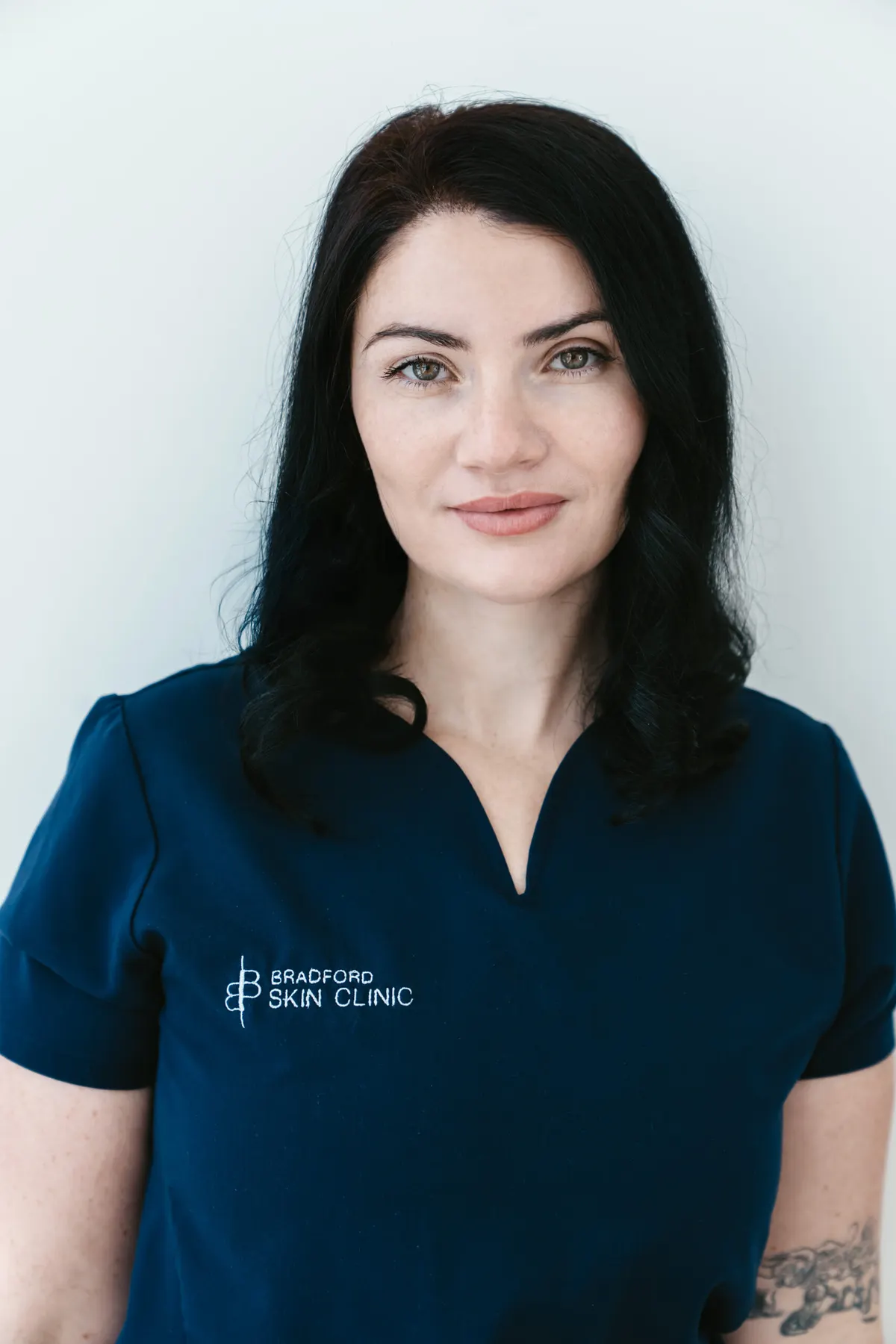
Every treatment in this clinic is carried out by a licensed clinician - never a technician, never someone on a weekend certificate. Your treatment plan is then signed off by Alex Dinovich, FNP-PHC, our Nurse Practitioner & Medical Director, who has more than eight years in injectables, skin health and laser.
- Performed by Kaitlyn Meli, RPN · Ashley Bravo, RPN · Yuliya Leonov, RPN
- Signed off byAlex Dinovich, FNP-PHC - Nurse Practitioner & Medical Director
- Licence#13564840
- Experience8+ years in injectables, skin health and laser.
How it works
Four appointments'
worth of care.
Nothing here happens on the same visit you first walk in, unless you want it to and it is right for you. This is the order we work in.
- 01
Consult
We look at what is actually bothering you, ask what you have tried, and tell you honestly whether this is the right treatment. Costs nothing and commits you to nothing.
- 02
Plan
Your clinician maps the plan with you and agrees it before you commit to anything. The plan is signed off by our Medical Director before treatment begins.
- 03
Treatment
Your clinician carries out the plan exactly as it was agreed. You are told what is happening, where and why, before it starts - and the quoted price does not change on the chair.
- 04
Review
We see you again to check the result and adjust the plan for next time. The first appointment is the start of the plan, not the whole of it.
What it costs
Where this
treatment starts.
Skin Tag Removal starts at from $150 for the first 20 minutes. That is where it starts, not a figure everybody pays: your plan is confirmed in person before anything is booked.
The consultation is free, and the number you are given at it is the number you pay. It does not change once you are in the chair.
- ConsultationFree
- Skin tag removalfrom $150 for the first 20 minutes
- Plexr eyelid treatment from $499
- Laser hair removal from $30
- Morpheus8 from $499
Published prices
| Area or option | Single |
|---|---|
| Skin tag removal First 20 minutes | $150 |
| Broken capillaries or cherry angioma Per 20 minutes | $150 |
Prices are in Canadian dollars and subject to applicable taxes. Pricing may be updated from time to time. Your booked package price is always honoured. Guide updated June 2026.
Questions people actually ask
Straight answers.
What is a skin tag?
A skin tag, or acrochordon, is a small soft benign growth of skin attached by a narrow stalk. They appear most often where skin rubs against skin or clothing: the neck, the underarms, the eyelids, under the breasts and in the groin. They are harmless, and they are removed for comfort or appearance rather than for medical necessity.
Why do I keep getting them?
Friction is the main driver, which is why they cluster where skin folds and where collars and straps sit. They become more common with age and with weight gain, they often run in families, and they are more frequent in pregnancy and in people with insulin resistance or diabetes. If you have suddenly developed a large number, it is worth mentioning to your family doctor.
How are they removed?
Depending on the lesion, by fine excision at the base, by plasma device or by cautery. The choice depends on the size, the site and the thickness of the stalk. All of these remove the tag at its base rather than reducing it, which is what stops the same tag from persisting.
Can I remove a skin tag at home?
We would strongly advise against it. The home methods people use, thread ligation, over-the-counter freezing kits and cutting, risk infection, bleeding, scarring and, most importantly, destroying a lesion that was never a skin tag in the first place. If a lesion needed assessment, removing it at home removes the evidence too.
Does it hurt?
Local anaesthetic is used where appropriate, and most people describe the anaesthetic itself as the only sharp part. Small tags on thin stalks are often removed very quickly. Larger or thicker lesions take a little more and are anaesthetised properly first.
Will it leave a scar?
Usually a small flat mark that fades, and in most cases it becomes hard to find. Larger lesions and thicker stalks leave more behind than small ones. If you have a history of keloid or hypertrophic scarring, tell us at consultation, because that genuinely changes the risk and may change our advice.
Will they grow back?
A skin tag removed properly at its base does not regrow, but new ones can form in the same area, because the friction and the tendency that produced the first one have not changed. That is not a failed removal. Reducing friction where you can does help.
When would you refuse to remove something?
When it does not look like a skin tag. Pigmented, irregular, firm, growing, bleeding, itching or changing lesions are not removed cosmetically here, and moles are not treated as skin tags. Those need physician or dermatologist assessment, and we will tell you to get that done rather than removing something that should have been examined properly first.
Related treatments
Often considered
alongside.
If this is not the whole answer for your face, one of these usually is. Every one of them is planned by the same nurses, in the same room.
Come and see us
Get the real
number first.
The consultation is free, takes one appointment, and ends with a written plan and a price - whether or not you go ahead. If a form is not your thing, text us instead and a real person will answer.
- Clinic444 Holland St W, Unit 2
Bradford, ON L3Z 0G1 - Phone647-333-6805
- HoursMon, Tue, Thu 9am-7pm
Wed 9am-5pm
Fri, Sat 9am-4pm
Sun Closed